RECORDING FOREST SOUNDS
Passive Acoustic Monitoring (PAM) enables long-duration ecological oversight across dense forest canopies. Understanding the transmission of sonic energy through leaf layers, trunks, and temperature gradients is essential for unbiased data collection.
THE ACOUSTIC ARCHITECTURE OF FORESTS
A forest is neither a static cathedral nor a silent room. It is a constantly shifting, heterogeneous acoustic filter. Sound generated within a woodland does not travel as it would across an open prairie; rather, every branch, needle, trunk, and leaf surface induces sound scattering, diffraction, and viscous thermal absorption.
When high-frequency bird vocalizations or bat echolocation calls (ranging from 4 kHz up to 120 kHz) encounter a multi-tiered rainforest or boreal canopy, the dense surface area of green leaves scatters short wavelengths. Conversely, low-frequency mammal vocalizations (below 1 kHz) suffer far less from viscous foliage drag, traveling long distances through wood trunks with minimal impedance.
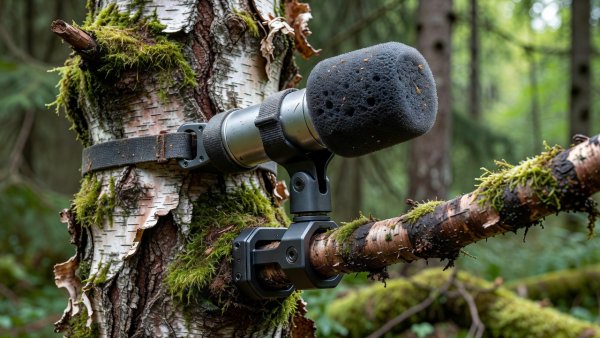
Trunk-Mounting vs. Free-Hanging
Mounting an omnidirectional capsule directly against tree bark creates a boundary-layer acoustic reflection (+6 dB across mid-bands). Free-hanging tethered mics avoid this gain bias.
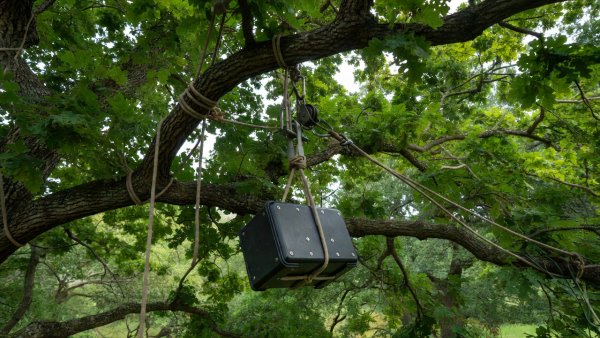
Vertical Recording Arrays
Canopy bioacoustic studies demonstrate that 60% of bat activity and specialized bird calls occur above 20 meters, completely missed by floor-level instruments.
PRACTICAL HARDWARE PROTOCOLS IN FIELD BOTANY
Setting up acoustic recording in wet forest environments requires balancing power budgets, moisture resistance, and acoustic transparency. Standard field protocols deployed by research institutions include:
| Hardware Class | Target Frequency | Primary Vulnerability | Calibration Method |
|---|---|---|---|
| Audiomoth PAM Units | 100 Hz – 192 kHz | Moisture condensation inside casing | Acoustic calibrator 94 dB @ 1 kHz |
| Wildlife Acoustics SM4 | 20 Hz – 48 kHz | Microphone diaphragm fungal growth | Pre-deployment test tone sweep |
| Ultrasonic Hydrophones | 10 kHz – 300 kHz | Biofilm fouling on wet root tips | Standard pressure hydrophone tank |
| Laser Vibrometers | 0.1 Hz – 50 kHz | Wind shake on supporting tripod | Retroreflective foil patch on leaf vein |
WIND AND RAIN ARTIFACT ELIMINATION
Rain is the primary spoiler of automated forest recordings. Droplets striking microphone housings create intense broadband transients that mask biological signals. To counter this, researchers design specialized conical rainhoods covered with open-cell reticulated acoustic foam.
Furthermore, wind blowing across leafy crowns creates low-frequency turbulence below 200 Hz. High-pass analog filtering at 150 Hz prevents microphone preamp clipping, preserving the critical frequencies where vegetation movements and wildlife vocalizations occur.
PROCEED TO PLANT VIBRATION