TESTING ENVIRONMENTAL RESPONSES
Separating biological mechanoreception from pseudo-scientific claims. A look at buzz pollination, root phonotropism, calcium signaling, and the strict controls required to avoid false positives.
MECHANORECEPTION WITHOUT A NERVOUS SYSTEM
Plants are physical organisms subjected to wind shear, gravitational pull, falling debris, and raindrops. They have evolved sophisticated cellular mechanisms to detect mechanical force—a phenomenon known as thigmoperception.
When physical vibrations bend cell walls, mechanosensitive ion channels (such as MSL proteins and MCA channels) in the plasma membrane stretch open. This enables a rapid influx of calcium ions (Ca2+) into the cytoplasm within seconds, triggering reactive oxygen species (ROS) pulses and altering gene transcription. There is no conscious experience involved; it is a direct biophysical response to mechanical strain.

Buzz Pollination (Sonication)
Roughly 8% of all flowering plant species (including tomatoes, potatoes, and blueberries) store pollen inside poricidal anthers. Pollen is only released when a bee vibrates its thoracic muscles at specific resonant frequencies (~300–400 Hz), physically expelling the grains like a salt shaker.
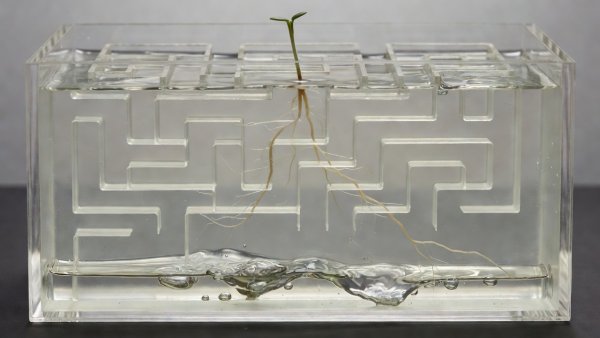
Root Phonotropism Trials
Studies led by Gagliano et al. (2017) demonstrated that Pisum sativum (pea) roots grow preferentially toward the sound of water moving inside closed pipes, even when no moisture gradient exists in the surrounding vermiculite substrate.
VERIFICATION CHECKLIST: DESIGNING A RIGOROUS PLANT ACOUSTIC EXPERIMENT
To avoid publishing artifacts, bioacoustics labs apply a four-point verification protocol before concluding a plant reacted to sound:
1. Acoustic Isolation Chambers
Testing must occur inside double-walled acoustic chambers isolated from external street traffic, elevator pumps, and building air-handling low-frequency hums.
2. Temperature & Humidity Matching
Speakers must be cooled or placed behind an acoustically transparent, thermally opaque mylar barrier to eliminate thermal micro-convection currents.
3. Vibration Control Tables
Airborne acoustic tests must be decoupled from the ground using pneumatic optical isolation tables, ensuring sound travels through the air and does not shake the soil via table legs.
4. Sham and White-Noise Controls
A response must be benchmarked against both absolute silence and randomized acoustic white noise of equal sound pressure (dB SPL) to confirm stimulus specificity.